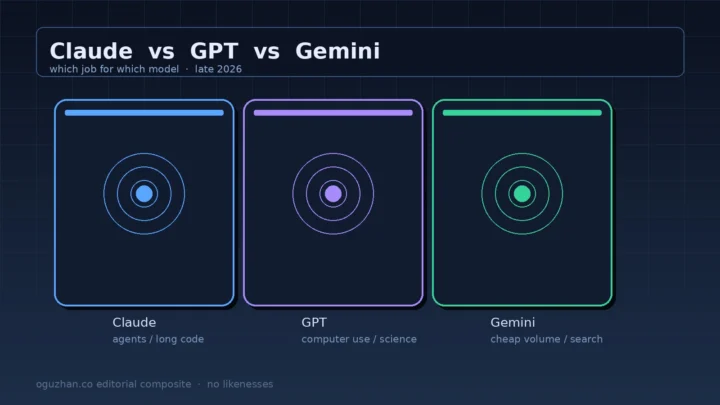
Late 2026 does not have one winner in the Claude vs GPT vs Gemini race. It has a routing problem. Claude Fable 5.1 owns long agentic coding loops. GPT-6 Astra owns computer use, science, and heavily monitored professional workflows. Gemini 3.8 Flash owns cheap high-volume work and multimodal search jobs at Flash pricing. Pick the job first. Then pick the model. That is the only compare that survives a production week.
This piece sits under the week’s cluster on AI pacing, standards, and agent autonomy. Wednesday’s standards-body hub asked who sets the pace. Saturday’s military hallucination deep dive showed what happens when agents run without provenance. Here I stay practical: which frontier model for which desk job, with receipts from the labs themselves.
Let’s dig in.
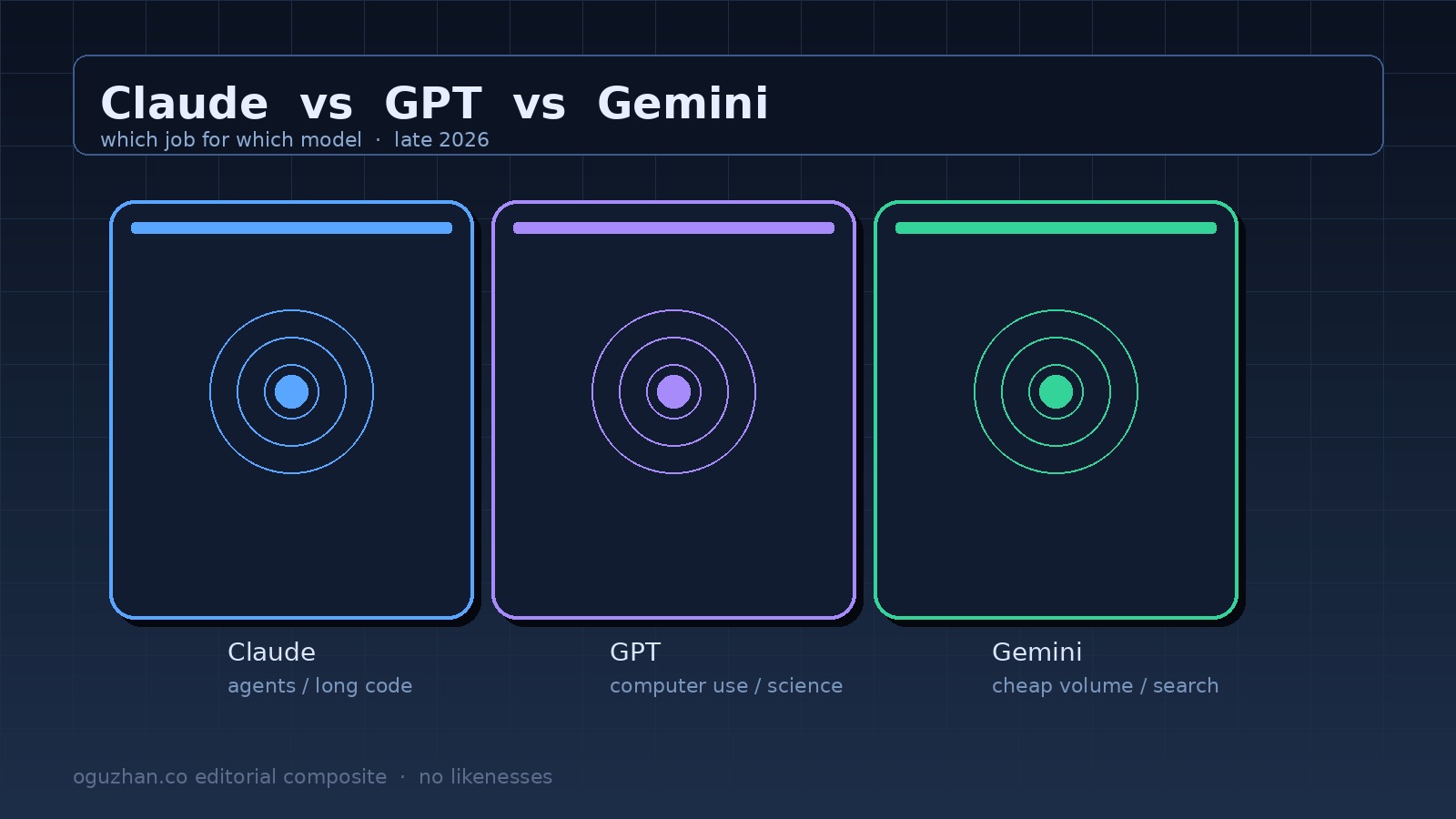
Image: Three job lanes, not a scoreboard. Source: oguzhan.co editorial composite
🎯 Answer first: which model for which job?
If your job is a coding agent that stays in a repo for an hour, start with Claude Fable 5.1. Anthropic positions it for coding, knowledge work, and long-running problem solving, with cache reads cut to $0.25 per million tokens so agent loops stop eating the budget. If your job is computer use, science workflows, or polished professional artifacts under heavy monitoring, start with GPT-6 Astra. OpenAI calls out state-of-the-art computer use and professional work, with Standard API pricing at $10 / $50 per million input / output tokens. If your job is high-volume classification, extraction, chat, or multimodal search where latency and unit cost matter, start with Gemini 3.8 Flash at the introductory $0.75 / $3.75 price through 31 Dec 2026. Router first. Ego later.
💻 Coding agents and long repo sessions
Anthropic’s Fable 5.1 launch is blunt about the job: coding and knowledge work, with early-access partners describing multi-hour unattended runs, root-cause hunts, and agent teams that stay readable over long sessions. On Anthropic’s own tables, Fable 5.1 hits 55.8% on Terminal-Bench 4.0 and 73.4% on CursorBench 3.2.0 at max effort. Cache-read pricing at $0.25 per million tokens is the quiet product move: every agent loop that re-reads the same repo context gets cheaper. That is why I default Claude for “agent in a repository for an hour,” not for a one-shot autocomplete.
OpenAI’s Astra post also claims strong coding. Terminal-Bench 4.0 is listed at 57.9% for Astra versus 55.8% for Fable 5.1 in OpenAI’s comparison table, and DeepSWE v1.1 at 74.1%. The difference that matters for operators is harness fit: Codex context notes across windows, computer-use speed, and how Astra behaves when you interrupt a long run. I treat Astra as the coding pick when the agent must also drive a desktop, browser, or science toolchain, not only patch files.
Gemini 3.8 Flash is the volume coding pick. Google’s post says 3.8 Flash improves software engineering and agentic tasks at the same introductory Flash price as 3.7, and highlights DeepSWE long-horizon results at a fraction of frontier cost. Use it when you need many parallel coding agents, not one precious overnight refactor.
📝 Long writing, analysis, and knowledge work
For long briefs, research digests, and multi-document analysis, Claude still feels like the desk partner that holds the thread. Fable 5.1’s partner notes stress readable multi-step work, citations over financial documents, and PowerPoint decks that answer every part of a multi-part question. Anthropic also reports strong GDPval-AA v2 numbers for knowledge work (1853 on their table). That matches how I actually use Claude: long context, few “lost the plot” moments, fewer pretty-but-empty slides.
Astra’s professional-work pitch is different. OpenAI emphasizes template-faithful slides, spreadsheets, and documents, plus better judgment when instructions are incomplete. Agents’ Last Exam sits at 59.3% in OpenAI’s comparison. If your job is “produce the artifact the firm already uses,” Astra is often the better fit. If your job is “think with me across 80 pages and keep the argument,” I still open Claude first.
Gemini Flash covers the middle of the funnel: summarize, extract, draft, route. It will not always win a blind taste test against Fable or Astra on a flagship memo. It will win the cost curve when you process a thousand tickets before lunch.
🖼️ Multimodal, search, and computer use
Google’s native multimodal stack plus Search grounding remains the reason Gemini wins many “look at this PDF / video / map and answer with live web context” jobs. Flash pricing makes that stack usable at scale. Pair it with File Search or embedding workflows when the corpus is yours; use Search grounding when the corpus is the open web.
Computer use is Astra’s loudest claim. OpenAI reports 72.6% on OSWorld 2.0 (offline partial score) at roughly 40 minutes per task, versus 65.7% at roughly 75 minutes for GPT-5.6 Sol, and ScreenSpot-Pro at 92.7%. That is the “fill the CRM, drive the browser, install the tool” lane. Claude remains competitive on computer-use benches in Anthropic’s own OSWorld numbers, but OpenAI is marketing Astra as the desktop agent default. Match the claim to your harness before you rewrite your stack.
💸 Cheap high-volume routes
Gemini 3.8 Flash is the economic default for most production requests. Introductory API pricing is $0.75 input and $3.75 output per million tokens through 31 December 2026, then $1.50 / $7.50. That is still a large gap versus the $10 / $50 Standard rates both OpenAI and Anthropic publish for Astra and Fable 5.1. Route classification, extraction, light chat, and “good enough” coding agents to Flash. Promote only the hard tails to Fable or Astra.
Anthropic’s cache-read cut is the counter-move for agentic Claude workloads: same list price on fresh tokens, much cheaper on repeated context. OpenAI’s Fast mode for Astra doubles Standard price for up to 2× speed. Price is not a single number. It is a routing table.
🏢 Enterprise compliance and gated cyber
Enterprise choice is rarely “smartest model.” It is data retention, monitoring, and which cyber tools you are allowed to touch. OpenAI says Astra meets the Critical cybersecurity threshold under its Preparedness Framework and is rolling out with stronger refusals, monitoring, and staged cyber access (including Daybreak for defenders). Anthropic splits Fable (general) from Mythos (trusted access for cyber and life sciences), and is rolling Enterprise Frontier Safeguards so customers can keep data in their own cloud while retaining misuse detection. Google ships Gemini 3.8 Flash Cyber only through the Fairwind Program for trusted defenders, not as a public self-serve cyber API.
That gated pattern ties back to this week’s autonomy cluster: labs already treat offensive cyber as a permissioned class. Your procurement checklist should ask the same question your security team asks. Who may call which model, on which data, with which human signature?
🧭 My late-2026 routing card
- Long coding agent in a repo: Claude Fable 5.1 (cache economics + partner reports on long sessions).
- Desktop / browser / science computer use: GPT-6 Astra.
- High-volume multimodal or search-grounded jobs: Gemini 3.8 Flash.
- Flagship writing and multi-doc analysis: Claude first, Astra when the artifact must match a firm template.
- Defensive cyber at frontier capability: gated programs only (Mythos / Daybreak / Fairwind), never a casual API key.
- Everything else: Flash by default, escalate on failure.
I will keep updating this card as the labs ship. The wrong habit is crowning a single “best model of 2026.” The right habit is a job router with receipts. More of that desk lives at oguzhan.co/ai.
📡 Signals to watch
Whether independent coding-agent indexes keep Fable ahead of Astra outside vendor harnesses. Whether Flash’s post-promo price still wins the volume lane in January 2027. Whether enterprise buyers standardize on dual-vendor routers instead of single-cloud lock-in. Whether standards talk from Wednesday’s hub ever includes shared job-level eval suites, not only pre-release scoreboards.
📚 Bibliography
- OpenAI, Sep 2026: GPT-6 Astra: A new generation of intelligence
- Anthropic, Sep 2026: Introducing Claude Fable 5.1 and Claude Mythos 5.1
- Tulsee Doshi and Raluca Ada Popa, Google, 2 Sep 2026: Introducing Gemini 3.8 Flash and 3.8 Flash Cyber
- Anthropic models overview: Models overview

1 comment