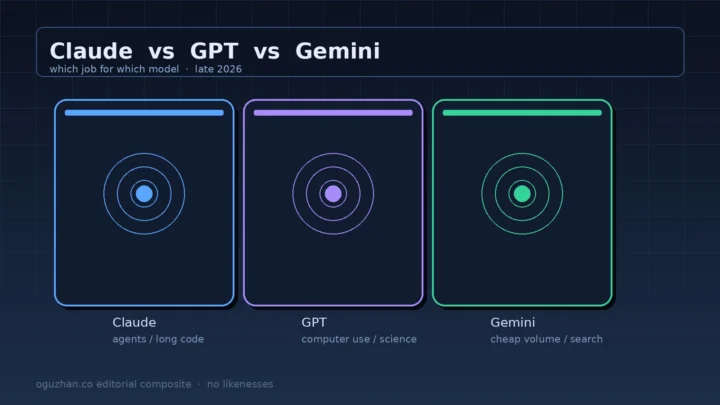
There is no useful single answer to “Which model wins?” in September 2026. The useful answer starts one level lower: what work is being routed, through which tools, under what latency and cost limit?
For a long coding session inside a repository, Claude Fable 5.1 is my first test. For a job that crosses a browser, desktop application, scientific tool, and finished office document, I would test GPT-6 Astra first. For high-volume extraction, classification, multimodal intake, or search-grounded work, Gemini 3.8 Flash gets the first production trial.
Those are starting routes, not medals. A different prompt, tool wrapper, or repository can reverse the order.
The short routing card
| Workload | First model to test | Reason to test it first | | — | — | — | | Long-running coding agent in one repository | Claude Fable 5.1 | Strong long-session positioning and unusually cheap repeated context | | Computer use across browser and desktop tools | GPT-6 Astra | OpenAI reports its clearest gains in computer use and professional workflows | | Template-bound slides, sheets, and documents | GPT-6 Astra | The launch focuses on completing professional artifacts, not just answering prompts | | Multi-document analysis and long-form knowledge work | Claude Fable 5.1 | Anthropic reports strong knowledge-work results and partner evaluations on complex documents | | High-volume extraction, triage, chat, and multimodal intake | Gemini 3.8 Flash | Much lower introductory token rates and native support for text, image, video, audio, and PDF input | | Search-grounded or Maps-grounded tasks | Gemini 3.8 Flash | Search and Maps grounding are part of the model's documented tool set | | Advanced defensive cyber work | A gated program | Mythos, Daybreak, and Fairwind have access controls; none should be treated as an ordinary public API route |
Why the benchmark tables do not settle it
Every major number in this comparison comes from a vendor page. Anthropic, OpenAI, and Google publish useful evidence, but their launch charts are not neutral leaderboards. The labs choose effort settings, tool harnesses, safeguards, model versions, task subsets, and cost assumptions. Even a benchmark with the same name can be run differently.
Anthropic reports 55.8% for Claude Fable 5.1 on Terminal-Bench 4.0 and 73.4% on CursorBench 3.2.0 at maximum effort. Its knowledge-work table gives Fable 5.1 a GDPval-AA v2 score of 1853. OpenAI's launch table puts GPT-6 Astra at 57.9% on Terminal-Bench 4.0 and 74.1% on DeepSWE v1.1. The same OpenAI table gives Gemini 3.8 Flash 73.8% on DeepSWE v1.1.
The caveats matter. Anthropic says Fable 5.1 was evaluated with production safeguards enabled and explains that interventions could reduce some scores. Its OSWorld 2.0 tasks came from the August 2026 release and are not directly comparable with earlier published OSWorld results. OpenAI says its cross-provider research setup is simpler than the production Codex configuration, and notes that provider safeguards and computer-tool implementations differ. For ScreenSpot-Pro, OpenAI says the reported Fable result comes from Mythos, the less restrictive configuration, rather than ordinary Fable.
A vendor chart can tell you what deserves a test slot. It cannot choose the winner of that test.
Route long coding loops to Claude first
Claude Fable 5.1 makes its strongest case when an agent must keep working after the easy edit is done. Anthropic's early-access accounts describe multi-hour unattended runs, root-cause investigation, verification loops, and work that stayed readable.
The pricing change supports that use case. Fresh input and output cost $10 and $50 per million tokens. Prompt-cache reads cost $0.25 per million tokens, while a five-minute cache write costs $12.50 and a one-hour write costs $20. An agent that repeatedly reads the same system instructions, repository map, conventions, or tool definitions can therefore have very different economics from a one-shot request.
OpenAI reports 57.9% for Astra against 55.8% for Fable 5.1 on Terminal-Bench 4.0. Astra also reaches 74.1% on DeepSWE v1.1 in OpenAI's table. Codex can preserve notes across context windows and search earlier windows instead of relying entirely on repeated compaction.
Start Fable when the agent mostly lives in code, tests, logs, and repository context. Start Astra when the job must also manipulate desktop software, browse, or produce a finished artifact. Run both on the same issues, then score accepted patches, regressions, review time, tool failures, and cost per merged change.
When volume dominates, include Gemini 3.8 Flash. Google claims strong DeepSWE v1.1 performance at a fraction of larger-model cost, but warns that higher effort may use more reasoning steps, tool calls, and tokens.
Separate knowledge work from artifact production
“Write a report” hides two different jobs.
The first is sustained analysis across many documents. Anthropic cites partner tests involving financial-document recall, multi-part questions, PowerPoint output, and long research runs. Its GDPval-AA v2 result is 1853. That makes Claude a sensible first route for a large evidence pack.
The second job is artifact completion: use a template, edit a spreadsheet, build slides, and return something that fits the firm's workflow. GPT-6 Astra targets that lane. OpenAI reports 59.3% on Agents' Last Exam. That is OpenAI's result in its setup, not your assignment's success probability.
Gemini 3.8 Flash handles the intake layer well on paper. Its model documentation supports text, images, video, audio, and PDFs, plus File Search, code execution, function calling, URL context, and grounding with Google Search and Google Maps. That combination is attractive for processing a large mixed-media queue before sending difficult cases to Fable or Astra.
A two-stage route can work well: Flash extracts and classifies, then uncertain cases move to Fable or Astra. Measure false negatives at that boundary.
Astra gets the first computer-use trial
OpenAI's most specific Astra case is computer use. It reports 72.6% on the offline partial-score set of OSWorld 2.0 at roughly 40 minutes per task. GPT-5.6 Sol is listed at 65.7% and roughly 75 minutes. ScreenSpot-Pro is reported at 92.7%.
Again, attribution and setup belong beside the numbers. These are OpenAI's results. The OSWorld figure is an offline subset and a partial score, not a universal desktop success rate. ScreenSpot-Pro tests visual target location without tools; it does not prove that a long browser workflow will survive authentication, pop-ups, ambiguous permissions, and a changed interface.
Still, Astra should get the first trial for CRM updates, browser-to-document work, software installation, or scientific applications. Record completion, wrong clicks, unauthorized actions, elapsed time, interruption recovery, and human rescues.
Price the route, not the prompt
At Standard short-context rates, Fable 5.1 and Astra both list fresh input at $10 and output at $50 per million tokens. OpenAI lists Astra cached input at $1 and cache writes at $12.50. Anthropic lists Fable cache hits at $0.25, with separate write rates.
OpenAI's Astra Fast mode costs twice the applicable Standard rate and promises up to twice the speed. For short context, that means $20 input and $100 output per million tokens. Long-context rates differ, and Fast mode is unavailable for Astra with EU data residency.
Gemini 3.8 Flash has a dated promotion. Through December 31, 2026, Google lists $0.75 per million input tokens and $3.75 per million output tokens, including thinking tokens. On January 1, 2027, those rates become $1.50 and $7.50. Search grounding can add separate request charges, so token price is not the entire bill.
Build cost models from traces. Include retries, tool calls, cache writes, cache hits, search fees, failed runs, and human review. “Price per million tokens” is procurement data. “Cost per accepted result” is routing data.
Cyber capability is a permissioned route
The cyber variants need a separate policy branch.
Anthropic says Claude Fable 5.1 and Claude Mythos 5.1 share the same underlying model, but Mythos has more permissive safeguards for vetted cybersecurity and life-sciences users. General Fable access is not a substitute. Mythos access runs through trusted programs, and the launch says it is currently limited to a set of US organizations while Anthropic works to expand it.
OpenAI says GPT-6 Astra reached the Critical cybersecurity threshold under its Preparedness Framework. Ordinary Astra refuses more advanced requests such as creating proof-of-concept exploits. OpenAI points approved defensive work toward staged Daybreak access. The current Daybreak aliases map to GPT-5.6 Sol and GPT-5.6 Cyber, so “Daybreak” should not be used as another name for unrestricted Astra.
Google limits Gemini 3.8 Flash Cyber to trusted defenders through the Fairwind Program. Google identifies government authorities, critical-infrastructure operators, and software maintainers among the priority groups. Public Gemini 3.8 Flash and the restricted Cyber variant are different routes.
The production question is therefore not just which model can perform the task. It is whether the caller, data, target system, authorization, and requested action satisfy the program and the organization's own controls.
A router that can survive next month's releases
Start with four lanes: low-cost volume, long coding, computer use, and restricted high-risk work. Give every request a data class, maximum spend, latency target, required tools, and escalation rule. Pin model versions where the API allows it. Keep a small set of real tasks as regression cases.
Then evaluate the system, not the brand. A model switch can change tool syntax, refusal behavior, token use, and review burden even when benchmark scores rise. Re-run the harness after prompt changes, tool updates, and vendor releases.
My September 2026 defaults are simple: Gemini 3.8 Flash for the broad inexpensive first pass, Claude Fable 5.1 for deep repository and document work, and GPT-6 Astra for computer use and tightly specified professional artifacts. Cyber work goes through approved programs. Any of those routes can lose when the local harness speaks.
Sources
- Anthropic: Introducing Claude Fable 5.1 and Claude Mythos 5.1
- Anthropic: Claude API pricing
- Anthropic: Models overview
- OpenAI: GPT-6 Astra, a new generation of intelligence
- OpenAI: API pricing
- OpenAI: GPT-6 Astra model documentation
- Google: Introducing Gemini 3.8 Flash and 3.8 Flash Cyber
- Google AI for Developers: Gemini API pricing
- Google: Fairwind Program

1 comment