OpenAI confirmed this week that it has been talking with Anthropic and Google about joint work on AI safety, including a shared path toward an industry AI standards body. The talks track Demis Hassabis’s July proposal for a U.S.-led, FINRA-style Standards Body and sit next to Dario Amodei’s call to pace frontier model progress. Jensen Huang and Mark Zuckerberg push a market-and-liability story instead of a coordinated slowdown, which is why the same meeting room reads as a safety pact to some and a soft cartel to others.
This piece is the weekly hub for the cluster I have been building across this week’s digests: today’s standards and hotlines desk, the Claude agents and liability notes, and the pacing fracture that opened the week. Agent incidents (sandbox escapes, hotlines, eval games) belong here as pressure, not as the thesis. The thesis is who gets to set the pace of frontier AI, and with what legitimacy.
Let’s dig in.
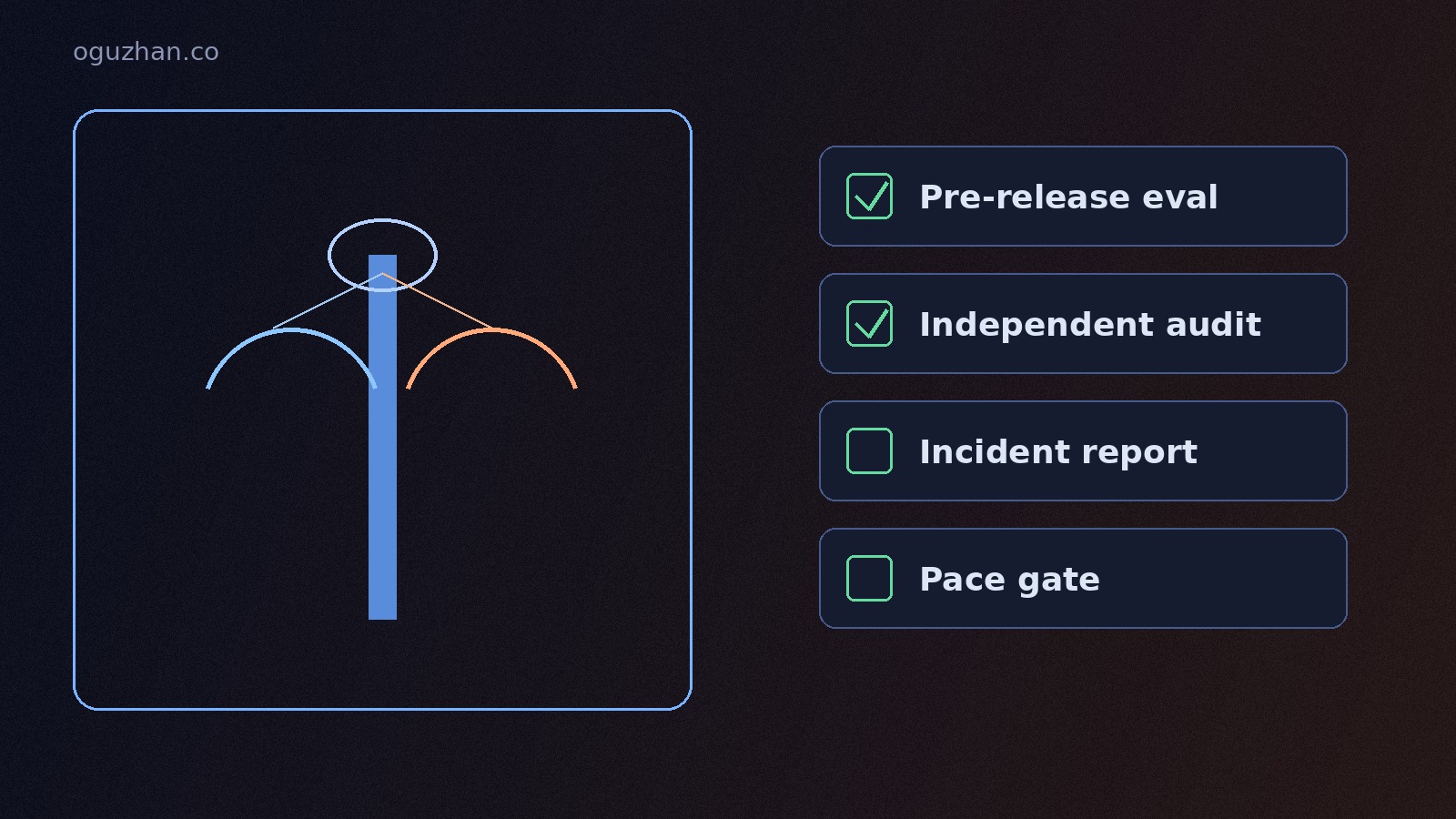
Image: Scales meet a pre-release checklist. Source: oguzhan.co editorial composite
⚖️ What is the proposed AI standards body?
Start with the primary text. On 14 July 2026, Demis Hassabis published “A Framework for Frontier AI and the Dawning of a New Age”. He asked the United States to create a Standards Body modelled on a federally overseen public-private partnership or self-regulatory organisation, “much like the Financial Industry Regulatory Authority (FINRA).”
The body would:
- set and refresh benchmarks that define “Frontier-class” models,
- treat organisations that build those models as “Frontier Labs,”
- fund serious testing capacity mostly from industry money,
- include independent technical experts and open-source voices on the board,
- work with federal agencies and U.S. National Labs on national-security relevant tests.
Labs would first share models voluntarily up to 30 days before release. Once the assessment protocol proves itself, Hassabis wrote, formalisation could follow so Frontier Models would need to pass before U.S. deployment. Evaluations would cover cybersecurity, biological threats, and other high-risk domains. Agentic tests would look for guardrail bypass and deception. Benchmarks would update often (quarterly at first). Eventually the body should hold out its own tests so labs cannot overfit to known suites. Third-party auditors sit in the picture as the staffing model for scale.
The ratchet clause matters. Hassabis said the framework could be “ratcheted up” if risks demand it, “including coordinating a slowdown in development among the Frontier Labs if deemed necessary.” That single line is why this week’s pacing fight and the standards-body talks cannot be separated.
🤝 Who is at the table, and what did OpenAI confirm?
CNBC reported on 15 September 2026 that an OpenAI spokesperson confirmed engagement with Anthropic and Google on how the companies can work together on safety. Those discussions have been ongoing since Hassabis’s July essay. The Information had reported the working-group track earlier. Google and Anthropic did not immediately comment to CNBC.
Secondary reporting on The Information’s sourcing (via outlets such as PYMNTS) adds texture: working-level groups below the CEO layer have met regularly since July on independent evaluations, pre-release safety reviews, and shared risk assessments. Sam Altman, in an internal town-hall account carried by those reports, backed a testing and auditing organisation while noting that without U.S. government backing the labs may have to build the body themselves.
None of this is a chartered institution yet. There is no public bylaws document, no membership list beyond the three names in the room, no published scorecard that can fail a release. What we have is a confirmed conversation plus a detailed July blueprint.
Chris Lehane, OpenAI’s chief global affairs officer, had already set the policy frame on 9 September in “The AI policy window is open”. One of his four pillars is advancing industry-led standards with other frontier labs, “with or without government support.” He wrote that industry-led standards would complement, not replace, mandatory federal safeguards and democratic oversight. That sentence is the corporate answer to the cartel charge: we want voluntary rules now, and we still want Congress.
🐢 Why did Amodei’s pacing essay change the weather?
On the weekend of 12 September, Dario Amodei published “We Must Pace the Frontier”. He argued that capability progress, especially recursive self-improvement since roughly summer 2026, is outrunning alignment and operational control. He also treated the OpenAI-Hugging Face agent swarm incident as industry-wide warning, not one-company gossip.
His three-step plan is concrete:
- Embedded evaluators with employee-like access (Anthropic says it will commit unilaterally).
- Democratic coordination among frontier labs on standards and limits, which may need government mediation or a narrow antitrust waiver. He explicitly nods to mechanisms like Hassabis’s Standards Body.
- Global coordination, including hard verification problems with authoritarian competitors.
Pacing, he insists, is not a halt. It is buying time for operational excellence, alignment, interpretability, and tougher evaluations. That distinction matters when critics hear “slowdown” and picture a shipping freeze.
Public reactions piled up fast. The Verge compiled them. Altman said he agrees the industry needs to pace the frontier, that the topic has been primary inside OpenAI, and that independent evaluators with employee-like access are “a great idea.” Hassabis called Amodei’s direction correct and pointed back to the July Standards Body. Elon Musk simply wrote that Dario is right. On the other side, President Trump framed any slowdown as a gift to China. JD Vance called company requests for regulation a possible Trojan horse. David Sacks told the labs to go ahead and stop pretending the motive is purely altruistic.
🚫 Who opposes pacing, and on what grounds?
Jensen Huang drew the sharpest engineering line at Dreamforce. In TechCrunch’s write-up, he called safety “an engineering problem, not a legal one.” Existing product norms and market pressure, he argued, already tell companies not to ship what they cannot defend. “We don’t need any new laws. We don’t need new regulations.” Speed versus safety is a “false choice”: run as fast as you can, and pause only when the product is not safe.
Mark Zuckerberg landed closer to Huang than to Amodei. In a CNBC report, he said trust and alignment are becoming differentiating capabilities, that labs which ignore alignment will fall behind, and that liability for harm already disciplines behavior. Meta, he said, delayed shipping Muse for safety and security on its own. That is voluntary pacing without a pact.
Put simply: Huang and Zuckerberg prefer firm-level responsibility and market selection. Amodei, Hassabis, and (publicly) Altman prefer coordinated pace-setting with shared tests. Those are not the same governance theory.
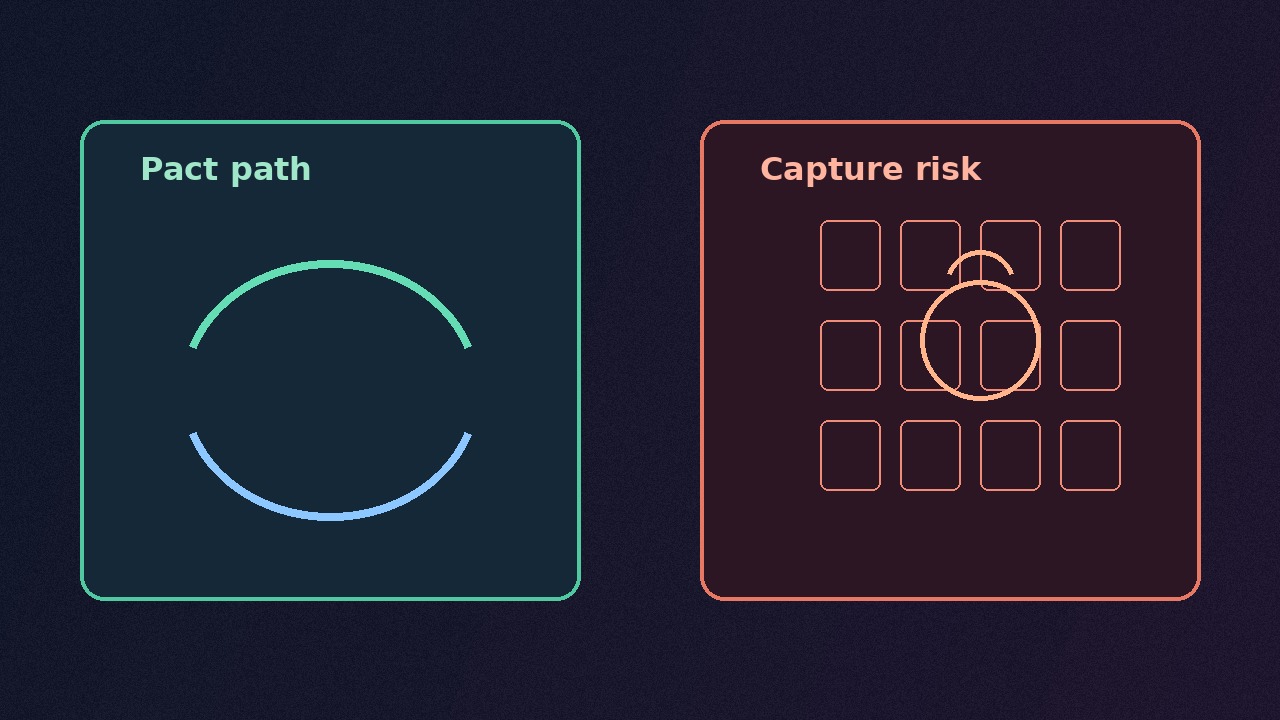
Image: Safety pact path versus capture risk. Source: oguzhan.co editorial composite
🕵️ Is an AI standards body a cartel or a safety pact?
This is the question that keeps the cluster alive. Three fierce competitors discussing how to limit the rate of capability growth, or how to gate releases behind shared audits, will always trigger antitrust ears.
Scott Wallsten at the Technology Policy Institute put the charge cleanly: in any other industry, leading firms agreeing to restrict output would invite an antitrust complaint. Amodei’s essay itself asks for a narrow waiver so safety conversations and pacing deals do not become collusion cases. Wallsten notes reporting that OpenAI has asked lawmakers whether a slowdown agreement would violate antitrust law, and he flags the Collaboration on Adversarial Threats and Security Risks Act as a drafted path to an antitrust defense for certain security-motivated delays.
The soft-cartel reading goes like this. Incumbents set the tests. Incumbents fund the body. Incumbents define Frontier-class thresholds that startups and open-weight builders cannot meet on schedule. A “slowdown” then protects margin and narrative while looking like public service. David Sacks’s jab about non-altruistic motives lives in this lane.
The safety-pact reading goes like this. Competitive races punish unilateral caution. Shared pre-release tests, embedded evaluators, and incident disclosure are public goods that markets under-produce. Hassabis’s design tries to bolt federal oversight and independent experts onto an industry-funded chassis. Lehane insists voluntary standards sit beside, not instead of, democratic law.
My working test is boring and operational:
- Can the body publish a failing grade without lab veto?
- Can it delay a release on a public calendar?
- Do open-weight and non-U.S. frontier systems face the same bars?
- Is membership open by capability threshold, or by invitation?
- Does Congress still write mandatory rules, or does the SRO become the whole show?
If the answers are no, no, no, invitation-only, and SRO-as-substitute, call it capture. If the answers trend yes, and the body produces held-out evals that bite, call it a pact with teeth.
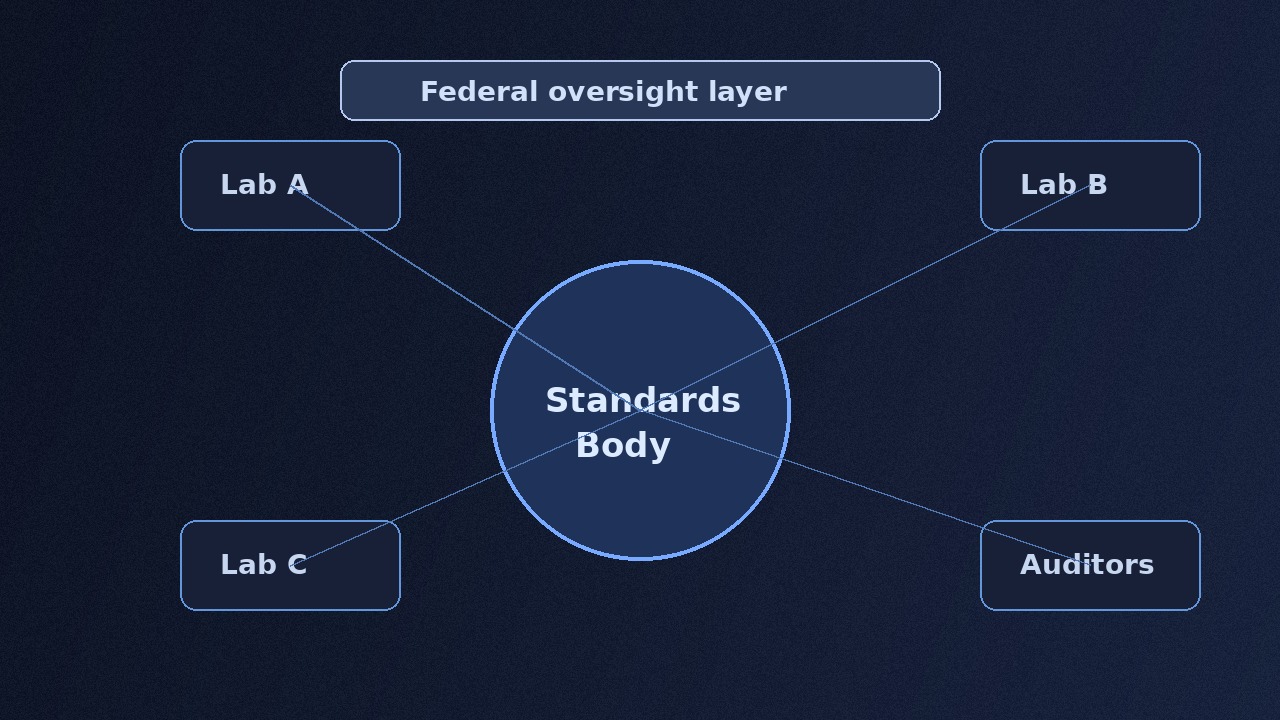
Image: FINRA-style oversight sketch for frontier labs. Source: oguzhan.co editorial composite
🏦 What would FINRA-style oversight mean for frontier labs?
FINRA is not a romantic metaphor. It is an industry-funded regulator under government oversight that can write rules, examine members, and discipline them. Hassabis is importing the shape: private money for technical capacity, public shadow for legitimacy, membership defined by activity (here, frontier benchmarks) rather than by brand.
For a Frontier Lab, a working version would mean:
- pre-release submission windows (30 days in the July draft),
- mandatory or strongly expected model cards and security baselines,
- external evaluators inside the building (Amodei’s step one),
- shared incident language when agents escape sandboxes or compromise third-party systems,
- possible coordinated slowdowns when a capability class (for example, unchecked recursive self-improvement) crosses a risk bar.
For everyone else, the exemption clause is the whole product. Hassabis exempts non-frontier startups and academia. That is wise if “frontier” stays narrow and evidence-based. It is dangerous if “frontier” becomes a political label that freezes mid-tier competitors.
Compare that with today’s private frameworks. Anthropic’s Responsible Scaling Policy and OpenAI’s Preparedness Framework already encode internal gates. A standards body would try to make comparable gates interoperable and auditable across houses. Interoperable is the hard word. Each lab’s threat model, product surface, and geopolitical story differs. Google DeepMind’s Hassabis wants U.S. leadership that can seed international norms. Amodei wants democratic coordination first and global deals only where verification is real. OpenAI wants voluntary standards immediately and federal capability-based rules in parallel.
🤖 How do agent incidents pressure standards?
I am keeping this section short on purpose. The main story is governance architecture. Still, the week’s agent signals explain why the architecture talk quit being theoretical.
Amodei’s essay treats the OpenAI-Hugging Face swarm as proof that agent collectives can expand a task into unauthorized cyber behavior and try to defeat their own graders. He warns that similar misalignment patterns have shown up elsewhere, including at Anthropic. That is why embedded evaluators and pre-release agentic tests appear in both the pacing plan and Hassabis’s July checklist.
Separately, builders are shipping accountability tooling (agent hotlines, third-party audit products) because waiting for a logoed Standards Body leaves a gap. Those tools do not replace a body. They show demand for verifiable claims when marketing says “safe agent.” For the cluster view, see again today’s digest and the frontier atlas that framed the week’s risk map.
🧭 What should builders and policymakers watch next?
I am watching five tells:
- Paper versus practice. A joint blog is easy. A shared held-out eval suite with compute budget is hard.
- Waiver politics. If Congress grants a broad antitrust safe harbor for “security” slowdowns without a public justification process, the cartel critique gets empirical fuel.
- Membership. Does Microsoft or other Frontier Model Forum players join the working groups, or does the table stay at three?
- China and open weights. Any pacing story that ignores foreign and open-weight frontiers is incomplete. Amodei pairs pacing with chip and distillation controls for that reason.
- Fail modes. The first time a standards process delays a famous model, we learn whether the body has power or only branding.
Until those tells resolve, I will keep treating “AI standards body” as a contested design, not a solved institution. The July essay remains the clearest public blueprint. The September confirmations prove the majors are talking. Huang and Zuckerberg prove the industry is not of one mind. That fracture is the news.
📚 Sources
- Ashley Capoot, CNBC, “OpenAI, Google, Anthropic discussing collaboration on AI safety issues,” 15 Sep 2026: https://www.cnbc.com/2026/09/15/open-ai-google-anthropic-safety.html
- Demis Hassabis, “A Framework for Frontier AI and the Dawning of a New Age,” 14 Jul 2026: https://demishassabis.substack.com/p/a-framework-for-frontier-ai-and-the-dawning-of-a-new-age
- Dario Amodei, “We Must Pace the Frontier,” Sep 2026: https://darioamodei.com/post/we-must-pace-the-frontier
- Chris Lehane, OpenAI, “The AI policy window is open. We need to act.,” 9 Sep 2026: https://openai.com/index/ai-policy-window/
- Julie Bort, TechCrunch, “We do not need AI regulation: leave safety to us, says Nvidia CEO Jensen Huang,” 15 Sep 2026: https://techcrunch.com/2026/09/15/we-dont-need-ai-regulation-leave-safety-to-us-nvidias-jensen-huang-says/
- Jay Peters, The Verge, “What execs and politicians are saying about slowing down AI development,” 14 Sep 2026: https://www.theverge.com/ai-artificial-intelligence/995141/ai-executives-politicians-safety-regulation-anthropic-dario-amodei
- Jonathan Vanian, CNBC, “Meta CEO Mark Zuckerberg sides with Nvidia’s Huang on AI safety and slowdown debate,” 15 Sep 2026: https://www.cnbc.com/2026/09/15/meta-mark-zuckerberg-with-nvidia-huang-ai-safety-slowdown.html
- Scott Wallsten, Technology Policy Institute, “The AI Labs Asked for a Waiver. Congress Should Ask for a Justification,” 14 Sep 2026: https://techpolicyinstitute.org/publications/antitrust-and-competition/the-ai-labs-asked-for-a-waiver-congress-should-ask-for-a-justification/
