
Jev confidence turns uncertainty into something software can route, instead of asking a chat model to announce how sure it feels. Choice and Score answers carry the full probabilities distribution plus a confidence value from 0 to 1; Noul does not. The useful difference is operational: a system can act, ask for confirmation, or stop according to risk.
That is the part I kept coming back to while reading TypeSafe’s documentation. “I’m 95% sure” is still a string. A calibrated distribution can become a branch in code.
📐 How Jev confidence comes from the distribution
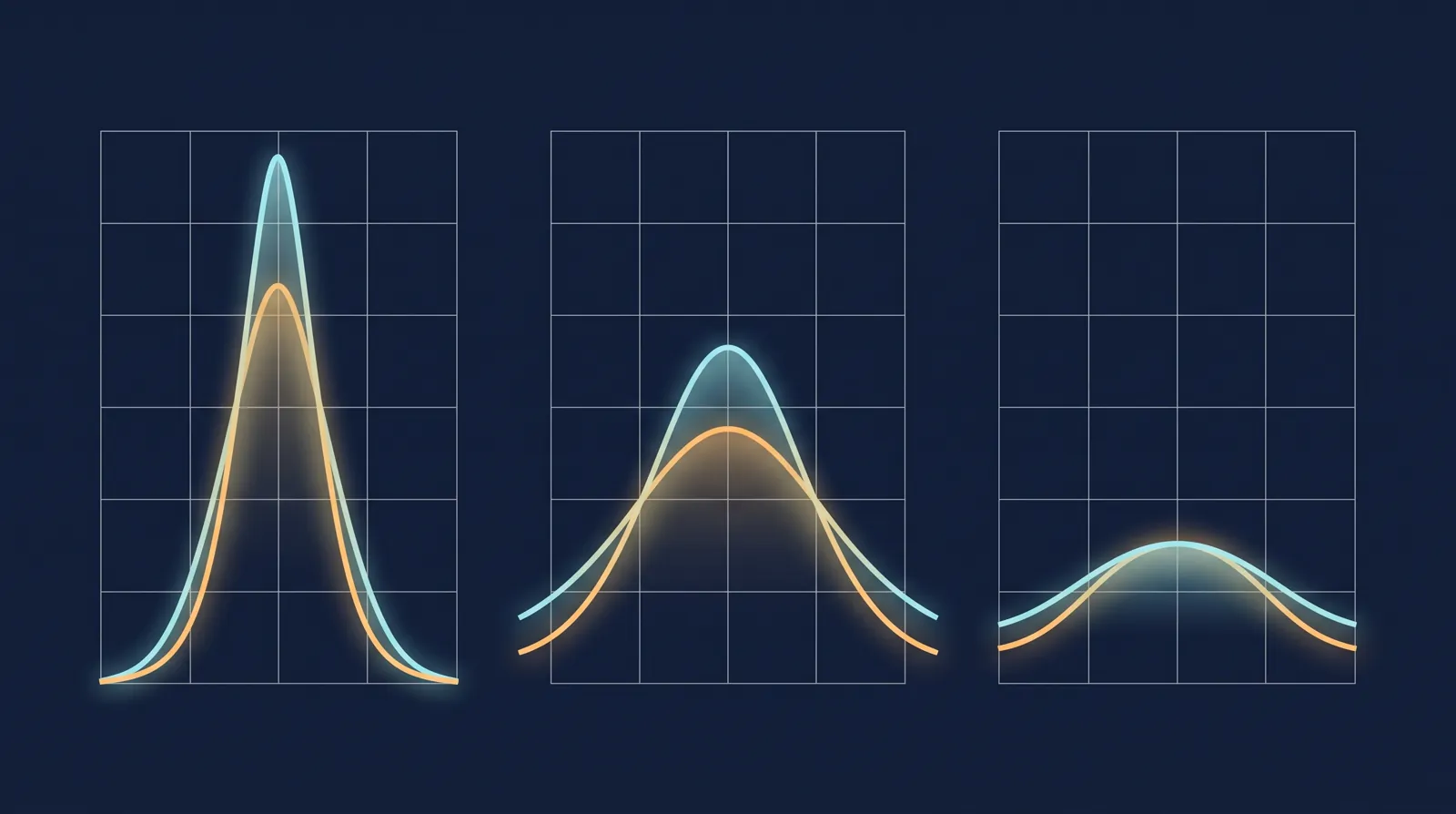
Day 1 of this series covered Jev’s three output primitives: Choice, Score, and Noul. Confidence does not sit beside them as a fourth primitive. It is derived from the shape of a Choice or Score answer.
Suppose a Choice has three options. A distribution concentrated on one option is peaked, so confidence is high. A nearly even split is flat, so confidence is low. TypeSafe’s confidence documentation gives a demonstration formula for three options:
(3 × largest probability − 1) / 2
That formula approximates confidence for the example. Jev computes the actual property, so an application does not need to reproduce it. More importantly, the response still includes all probabilities. Teams can inspect the distribution or apply another policy rather than being locked to TypeSafe’s single-number collapse.
Noul is the exception worth writing in the margin. It has no confidence property. That matches the primitives described yesterday: Noul represents a typed numeric quantity, while Choice and Score express a decision over options or ordered levels.
Low confidence is therefore not a malformed result. It is a useful “I don’t know” signal shaped for software. Chat interfaces often reward an answer that sounds settled. Decision infrastructure needs the opposite virtue when evidence is weak.
🎛️ Three paths, with thresholds scaled to risk

The clean routing pattern has three paths:
1. High confidence: act automatically. 2. Medium confidence: proceed cautiously, confirm, or gather more information. 3. Low confidence: do not act; clarify, fall back, or send the case to a person.
The numbers should follow the cost of a mistake. TypeSafe’s confidence-gated routing pattern uses a voice-banking Choice with check_balance, approve_transfer, and support. In that example, confidence below 0.6 goes to a support agent. A balance check can proceed at 0.6 or above, while automatic transfer approval needs more than 0.85; otherwise the user is asked to confirm.
Those values are an illustration, not commandments. The durable idea is asymmetric risk. Reading a balance and moving money may emerge from the same Choice, yet they should not share an automation threshold.
This also separates two questions that chat systems tend to muddle. The answer says what Jev selected. Confidence says whether the application should act on it. Product code retains the final word.
There is a practical bonus here. A threshold is visible, testable policy. A prompt asking a model to “be extra careful with transfers” is harder to audit and easier to interpret loosely.
🧪 RLCD trains for calibrated decisions

TypeSafe calls its training method Reinforcement Learning for Calibrated Decisions, or RLCD. Its target matters because confidence added after training is not automatically trustworthy.
The company’s machine-learning primer defines calibration across groups of outcomes. Events assigned probability 0.2 should occur about 20% of the time; those assigned 0.8 should occur about 80%; those assigned 1.0 should occur about 100%. This is not a guarantee that any single 0.8 answer is correct. It is a measurable relationship between forecasts and observed frequencies.
RLHF and RLVR pursue different rewards. RLHF optimizes human preference, while RLVR uses verifiable rewards. TypeSafe argues that preference training can encourage sycophancy, confident-sounding hallucinations, and mode dropping. A pleasing string is not the same object as a trustworthy unattended decision.
RLCD instead trains Jev toward calibrated decisions. In TypeSafe’s System One launch post, the contrast is explicit: LLM systems emit strings and often become inconsistent when asked to report confidence; Jev emits type-safe structured values with probabilities and confidence for Choice and Score answers. The stack combines a new model architecture, a parallel sampler, and RLCD.
The important claim is narrower than “the model knows when it is right.” Calibration means higher reported confidence should correspond to higher accuracy over repeated cases. That can be checked. It can also drift, fail on a new distribution, or be misused by an application with a careless threshold. The API makes doubt machine-readable; it does not abolish judgment.
⚠️ jev-1.13 is jagged, and the question still matters
Confidence is honest only when the task is well scoped. TypeSafe’s jev-1.13 jaggedness guide, reviewed on September 17, 2026, is unusually direct about where the model struggles.
jev-1.13 is built for common-sense System One judgment. Extra indirection, literal wording traps, math and counting, date comparisons, and large amounts of irrelevant state can push it off course. Adversarial content and contradictory instructions can do the same. Nor does asking a Noul and a Choice version of the “same” question guarantee a structural invariant between their answers.
Several remedies belong in ordinary code:
- Count and calculate in code.
- Extract dates with the model if useful, then compare them in code.
- Filter irrelevant state before sending it.
- Keep one judgment in one question instead of hiding several steps inside it.
- Avoid multi-hop System Two work and do not use Jev for generation.
This is more than a limitations footnote. A high-confidence answer to a muddled question does not rescue the question. The input state, criteria, and decision boundary remain engineering work.
The launch post describes Jev as a frontier-intelligence function call: unstructured state goes in, typed probabilistic decisions come out. Giving up string generation is part of that contract. Schema matching is guaranteed, but good schema design and task selection are still on us.
Calibrated doubt is a software feature
The series hub introduced System One decision models, and Day 1 examined the values Jev can return. Confidence and RLCD now explain how Choice and Score can carry enough uncertainty for an application to decide whether to trust, verify, or stop.
That beats chat bravado because it creates a control surface. Tomorrow’s feature entry will look at the speed and cost side of the same design, without pretending that fast decisions excuse badly framed ones.
