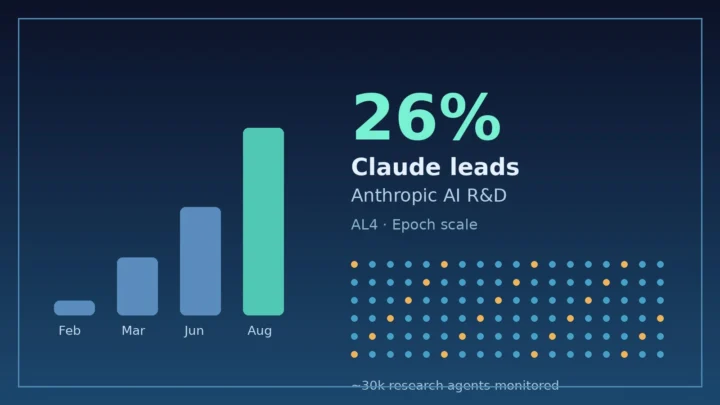
Anthropic has put a number on something frontier labs usually describe with anecdotes: Claude now "leads" 26% of the company's AI research and development work.
That does not mean Claude runs a quarter of Anthropic without people. The 26% sits at Automation Level 4, or AL4, on a scale developed by Epoch AI. At AL4, a person supplies a high-level prompt and supervises, while the model handles most of a task from end to end. Full autonomy is AL5. Anthropic found no AL5 work in any measured part of its AI R&D.
Still, the speed deserves attention. The AL4 share was below 1% in March 2026. By August it was 26%. More than 90% of the work had reached AL3 or higher, meaning Claude at least completed substantial portions under close human direction.
Five months changed the working arrangement inside one of the leading AI labs. That is the story.
What Anthropic actually measured
The new Anthropic R&D Automation Index begins with a map of the work rather than a survey asking employees whether AI makes them faster. During each week of July 2026, Anthropic sampled 20% of the staff in departments involved in model R&D. A Claude research agent reviewed internal records and produced a list of roughly 15,000 tasks.
Claude then arranged those tasks into a tree containing 542 categories. Among its 378 leaf categories were jobs such as diagnosing defects in an evaluation platform, setting network policy for reinforcement learning sandboxes, and writing postmortems for serving incidents. Anthropic froze that collection so later readings would measure automation against the same basket of work.
Each category received an AL0 to AL5 rating. The result was weighted by person-time, so a task occupying many employees counted more than an obscure job done occasionally. That weighting is rough, as Anthropic readily says, but it prevents a hundred tiny automated chores from masquerading as the core of model development.
The distinctions matter. At AL3, Claude collaborates: it does large pieces of the work, but a human remains closely involved. At AL4, Claude leads: it can investigate, implement, test and document most of a task after receiving a high-level instruction. The person reviews the result and retains the deployment decision. At AL5, the system notices the problem, decides what to do and ships the fix without requiring human involvement. Anthropic recorded zero AL5 subsets.
So the clean reading is neither "Claude builds Claude by itself" nor "this is just autocomplete." Humans still hold the final authority, but Claude already leads work representing 26% of Anthropic's measured R&D person-time.
A judge with an obvious conflict
There is a catch. Anthropic used Claude to research and rate work in which Claude participated.
The company tested that arrangement by asking employees who owned the relevant areas to score automation independently. Exact model-to-human agreement was 59%, while human-to-human agreement was 35%. Model and human ratings fell within one automation level 97% of the time. Those checks make the index useful as an internal trend, though they do not turn a self-assessment into an industry benchmark.
The fixed task basket introduces another limit. It measures how much of July's work becomes automated, but people may move into new kinds of work as old tasks pass to agents. Anthropic compared a January task tree with later records and found no increase in novel tasks through July at its chosen level of detail. Sensible check. It still plans to rebuild and version the basket periodically.
Comparable figures from OpenAI, Google DeepMind and other labs would tell us far more than another decimal point from Anthropic. A shared method and independent access are prerequisites. Anthropic says it plans to embed outside evaluators from several organizations and give them access similar to its internal risk teams. Dates and published findings will matter more than that promise.
Thirty thousand agents, watched twice
Automation at this scale creates a second measurement problem: can anyone see what the agents are doing?
On Anthropic's most-used internal platform, approximately 30,000 agents were doing research and engineering work at any one time in August 2026. Every action passed through an online monitor before execution, generally within seconds. Every action was also ingested by an offline monitor afterward. These coverage figures apply to that platform, not necessarily every agent system at Anthropic.
Across more than one billion agent decisions during August, the online monitor blocked 0.002%, about one in 47,000. Humans review blocked actions within a week. A tiny block rate is not automatically reassuring or alarming. It could reflect well-behaved agents, narrow permissions, an effective monitor, missed behavior, or some combination.
The offline system casts a wider net. It flags roughly one or two transcripts in every thousand for more review. About 100,000 transcripts enter a weekly classifier process, which dismisses most false positives and routine cases. The highest-priority group, approximately 50 cases per week, reaches human reviewers.
Those numbers expose the operational challenge better than a generic statement about human oversight. Thirty thousand concurrent agents can produce a billion decisions in a month. Even a low rate becomes a steady queue, while the people at the end must decide whether a strange sequence is harmless experimentation or the start of a serious failure.
Safety's share of the compute
Anthropic's third measurement covers compute allocation during one week, July 13 through July 20. About 6% of the compute used for AI R&D went to safety work. Within AI-driven AI R&D, the safety share was about 12%.
The company calls both estimates conservative. Work counted as safety only when its dominant purpose was making systems safer, more understandable or more secure. A workload that advanced capabilities and safety equally went into the ordinary R&D bucket. Safeguard classifiers were excluded, despite consuming a separate and reportedly comparable amount of compute.
Compute share is no virtue score. Safety research can demand months of researcher judgment and relatively few accelerator hours, while a training run burns enormous compute. The one-week sample also cannot show a trend. Its real value appears when labs use the same definitions over time and allow outsiders to inspect the classification.
Anthropic's release does not prove recursive self-improvement is here. It shows a fast move toward AI-led, human-approved research inside one lab: 26% at AL4, more than 90% at AL3 or above, and none at AL5. Paired with the scale of its agent platform, that is enough to retire the comforting idea that AI automating AI research is still a distant hypothetical.
The next useful update should come with independent verification. The one after that should come from a competitor.
