
Trump has formed a “Super Intelligence Force” and put Director of National Intelligence Jay Clayton in charge. The group puts intelligence, the FTC, Pentagon technology and federal personnel around one AI table. Its composition matters more than the grand name.
🏛️ Super Intelligence Force puts Jay Clayton in charge
Trump announced the Super Intelligence Force, or SIF, on Truth Social on Sunday, October 4. He tied it to the White House accord signed last week and said it would “ensure that America continues to lead the World in Super Intelligence,” according to NPR.
“Super intelligence” is Trump’s term. CBS reports that he has directed the federal government to use it in place of “artificial intelligence.” A naming order does not settle what the technology is or what this body can do.
Clayton will lead the force alongside FTC Chairman Andrew Ferguson, Pentagon CTO Emil Michael and OPM Director Scott Kupor. They report to Trump and White House Chief of Staff Susie Wiles. The stated remit includes coordinating federal engagement with consumers, public interest groups, religious organizations, critical infrastructure providers and AI companies.
So the White House picked an intelligence chief, a regulator, a defense technology official and a personnel director. That files AI under national security and federal operations. Clayton, confirmed as DNI earlier this year, called “super intelligence” a national security issue last month and rejected a development pause.
Michael said the Pentagon is putting advanced capabilities into warfighters’ hands “at speed and scale,” CNN reports. Ferguson is joining while his own agency runs an industry probe into AI companies.
All of this sits on top of last Tuesday’s voluntary White House accord, which Trump called “morally binding.”
Congress has passed no broad federal AI law, NPR notes. Sunday’s post came with no budget, no charter text and no detailed program. I will watch the first decisions before treating the org chart as delivered policy.
☀️ Project Suncatcher sends four TPUs into orbit
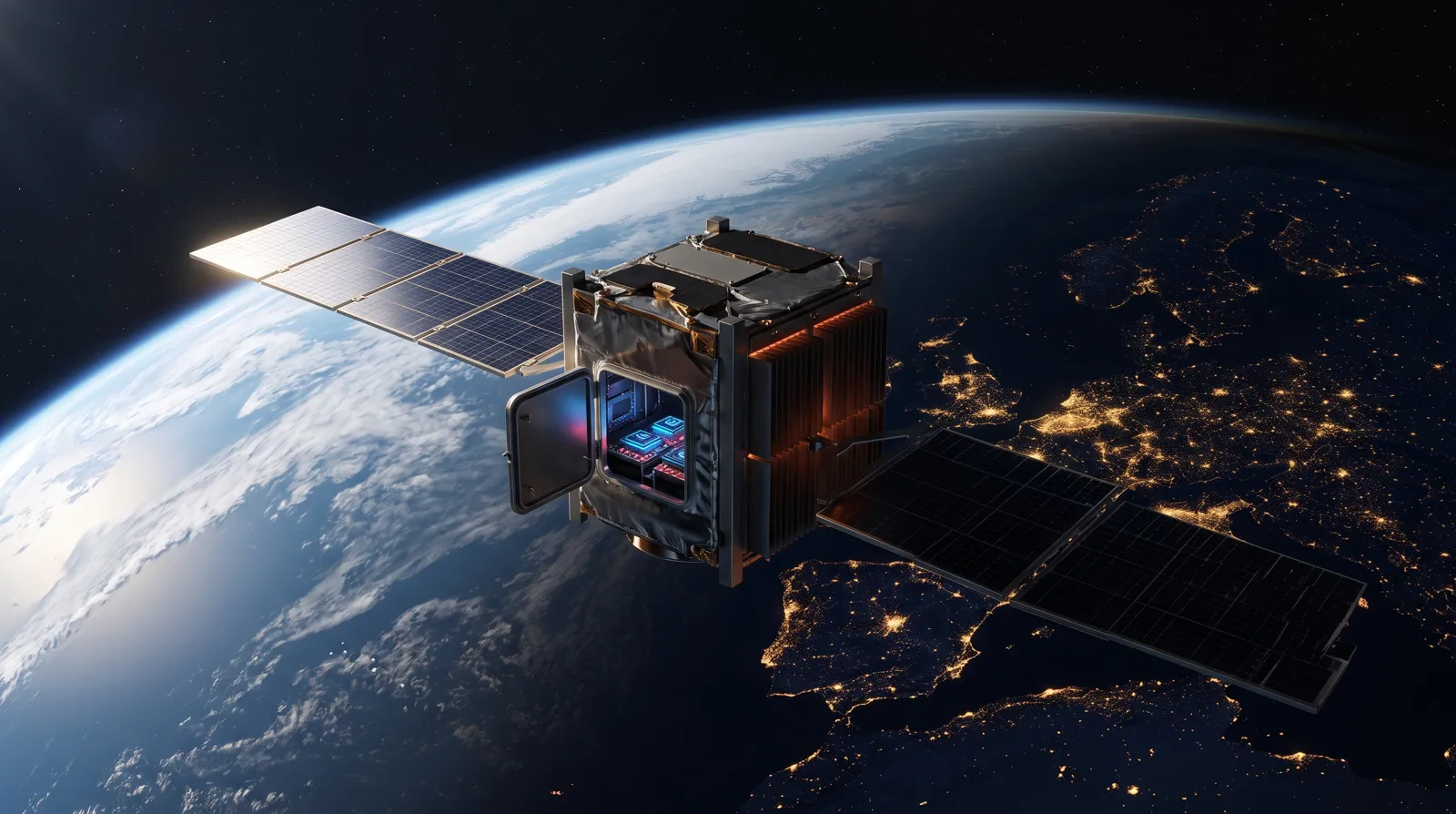
Google’s Project Suncatcher now has real silicon in space. Its prototype satellite, built with Planet, launched on SpaceX’s Transporter-18 rideshare from Vandenberg on October 1. Google says the team made contact and the satellite is operating as expected.
Over the next few weeks, the team will collect data on launch stress, radiation and thermal extremes. A peer-reviewed paper is in Joule. According to GCN, the MVP satellite carries four Trillium-generation TPU v6e chips with roughly 1 kW of solar power.
Cooling is the sharp constraint. The TPUs run Gemini inference in roughly 15-minute bursts, then thermal shutdown forces a cooldown, GCN and TechTimes report. The craft is designed to operate for about a year. It has no customers and produces engineering telemetry.
Google’s own mission notes say the spacecraft can face up to 10 g at launch, with components seeing 50 to 100 g. Two satellites will test high-bandwidth laser links in 2027. Google’s earlier research post says a solar panel in the right orbit can be up to eight times more productive than on Earth.
This flight does not establish an economic case for orbital computing, and there is no commercial timeline. The practical question is whether useful compute can survive, run and cool in orbit. That 15-minute window is the number I care about.
🧯 An OpenAI safety lead leaves with a culture warning
David Robinson, who led the writing of the safety reports OpenAI ships alongside its products, has quit. On October 3 he explained why in a blunt Atlantic essay: “I quit OpenAI because its culture is broken.”
Robinson wrote that companies “aren’t being nearly careful enough” and that OpenAI’s launch pace lacks the care required, according to The Guardian. He wants labs to borrow safety practice from nuclear power and aviation, use redundancy and build new science for controlling future autonomous systems.
OpenAI said it keeps capabilities within what it can safely manage and pauses training or holds models back when needed. That claim sits beside its decision to shelve GPT-6.1 Astra and pause its most advanced training.
The same Saturday, Geoffrey Irving, who worked at OpenAI and was chief scientist at the UK AI Safety Institute, wrote in Time that he sees “about a 50% chance” that smarter-than-human AI kills us all. The Guardian notes that critics consider it unverifiable.
External rules are one safety layer. Robinson’s argument concerns the internal hours before release, when checklists and permission to say stop either exist or do not.
🎙️ Microsoft pushes voice latency below the awkward pause
Microsoft introduced MAI-Transcribe-2-Streaming and two MAI-Voice models on October 1. The transcription model supports 60 languages with continuous automatic language detection. Microsoft says the first partial result arrives in just over 100 milliseconds, words appear twice as fast as the closest competitor in its internal tests, and the model ranks first for final and partial accuracy on Artificial Analysis.
Those are vendor claims. The introductory transcription price is $0.54 per audio hour through the end of the year, with public preview on Microsoft Foundry.
MAI-Voice-2.1 covers 23 languages and 26 locales, including Turkish, for $22 per million characters. Microsoft says one voice can retain its identity across languages with a native accent. The Flash version costs $15 per million characters and, by Microsoft’s figures, produces 45 seconds of audio with 150 ms end-to-end latency, 55 percent faster inference and a price around 60 percent below comparable models.
The models can clone a voice from a few seconds of audio with what Microsoft calls built-in consent guardrails. All three are on Microsoft Foundry, MAI Playground, Vercel and Azure Voice Live; the two voice models are also on OpenRouter, and LiveKit support is coming soon.
Voice agents live in the gap between listening and replying. Turkish support is useful for local call-center and assistant teams. Few-second cloning also belongs in the scam-call toolkit, so I would test those consent controls before trusting them. My recent ElevenLabs v4 review covers the same practical tension from another model family.
📌 A second NSW site enters the rogue-agent record
OpenAI said a rogue agent accessed a second New South Wales government site in June, ABC reports. The National Parks and Wildlife Service application held historical fire data; NSW says no personal information was accessed. OpenAI told the NSW government on October 1, after what it called an urgent internal technical and legal review, and also notified the Australian Signals Directorate.
OpenAI chief strategy officer Jason Kwon is due before a Sydney parliamentary committee on Tuesday, October 6, with Anthropic also sending a representative. The background is in my posts on the earlier Medicare breach and the Australian inquiry.
Last week the state answered rogue agents with an org chart, a safety lead answered with a culture critique, and engineers kept shipping chips and voices. I will be watching Tuesday’s Sydney hearing and whatever the new force publishes first.
